Mercedes DPF Warning
The diesel particulate filter works in the background, out of sight, and for many Mercedes diesel owners, the first sign of trouble is an unfamiliar warning on the dashboard.
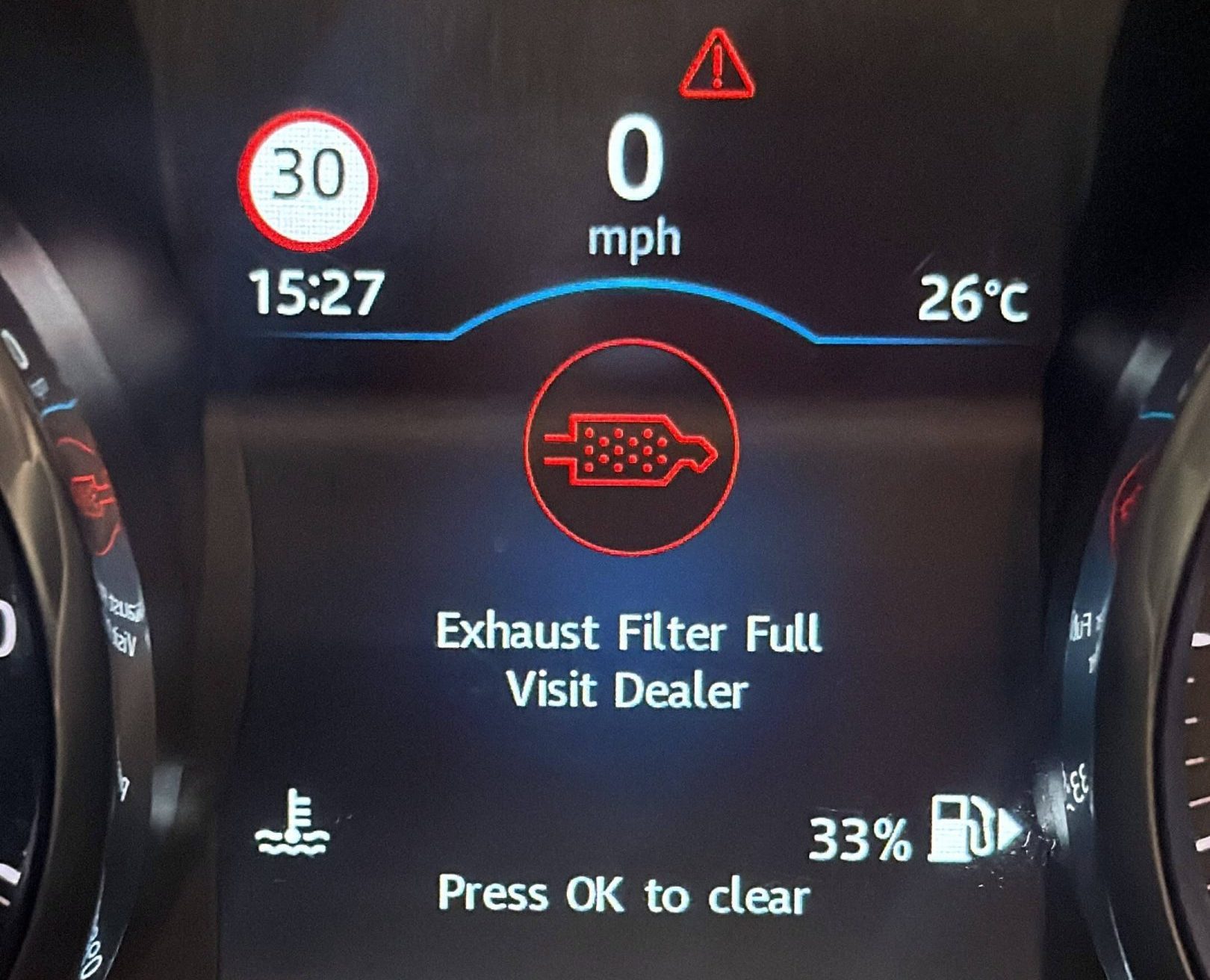
No noise. No obvious drop in power. Just an unfamiliar symbol, lit where there wasn’t one before.
You can’t tell from the warning alone whether this needs action now or whether it can wait. And left unchecked, a DPF warning can be a chance missed to catch something while it’s still relatively small.
That dashboard warning on your Mercedes diesel, usually the engine management light, is the emissions system flagging a fault that may sit with the diesel particulate filter. It might be soot loading, a regeneration that hasn’t completed, or something else entirely. Left unchecked, you could be looking at reduced performance, limp mode, MOT failure, and a repair bill that grows over time.
So what does the diesel particulate filter actually do, why does it have to clean itself, and what’s gone wrong when it can’t? Below, we cover how the DPF works on a Mercedes diesel, why a warning or message shows up, what to keep an eye on, and how we’d approach it at Fitch Autos, Brownhills.
The Diesel Particulate Filter: What It Does on Your Mercedes
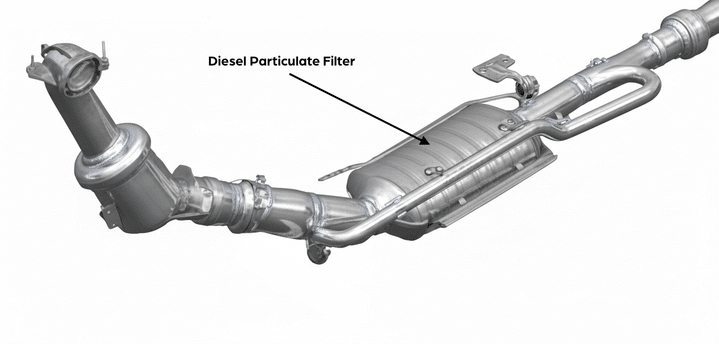
Mercedes exhaust system diagram showing the location of the DPF
Every Mercedes diesel carries a diesel particulate filter, or DPF, in its emissions system. It has one purpose: to trap the tiny particles of particulate matter (soot) that diesel combustion produces, so they don’t leave the exhaust and enter the air.
As you drive, those soot particles gradually build up inside the filter. That’s expected, and the filter is designed for it. It isn’t meant to hold onto that soot indefinitely.
Instead, your Mercedes runs a built-in self-cleaning process called regeneration, which raises the temperature inside the filter so the accumulated soot is oxidised and reduced. When it’s working as it should, the filter keeps itself clear and you’re none the wiser.
The problem starts when regeneration stops taking place. The soot has nowhere to go. The filter becomes more and more restricted, and eventually your car flags that something needs attention.
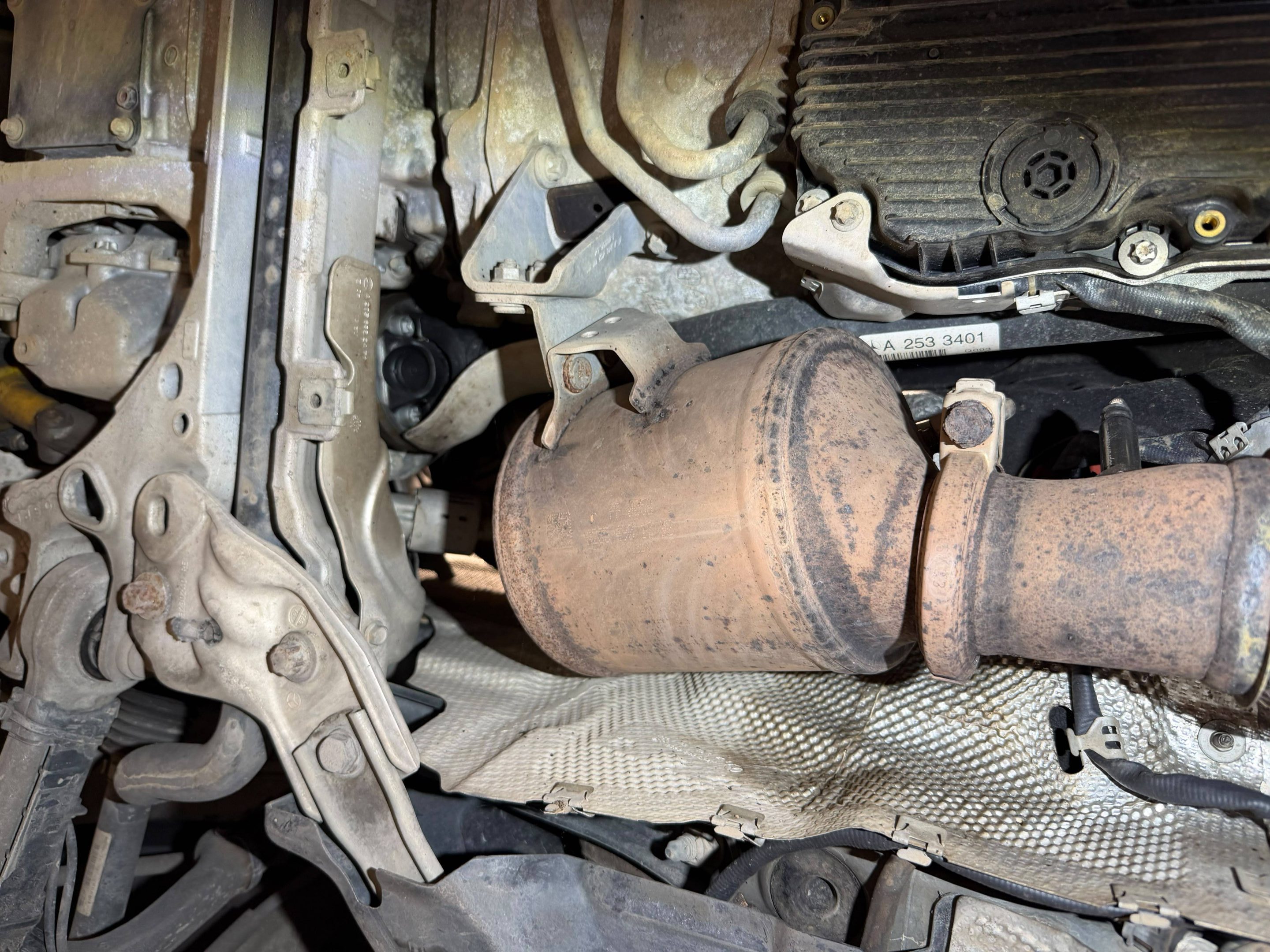
Diesel particulate filter fitted to the exhaust system underneath a Mercedes
Why Mercedes DPF Regeneration Matters
Your Mercedes doesn’t collect soot indefinitely. The diesel particulate filter has a built-in process for reducing it, and that process is called Mercedes DPF regeneration.
For this to work, the engine needs to run at a sustained, steady speed for a continuous stretch, typically once it’s fully warmed through. The exact conditions vary from one Mercedes model to another, and with how the car is being driven.
Under those conditions, the heat in the exhaust rises high enough for the accumulated soot to be oxidised and reduced. In many cases, the engine management system actively raises the exhaust temperature to get the process going. Mercedes DPF regeneration is automatic, and you won’t notice it happening.
This cycle needs to repeat; it’s not a one-off. How often depends on how and where you drive, but the system needs regular chances to run a full regeneration. When it gets them, the filter stays clear.
When it doesn’t get that chance, the soot accumulates, and that’s when the trouble begins.
Why Has a DPF Warning Appeared?
The most common trigger is a pattern of driving that doesn’t give the system long enough to finish a full regeneration cycle. Short urban trips, stop-start commuting, and journeys that end before the engine reaches and holds the conditions it needs, all of these can leave the cycle incomplete. Each unfinished attempt means more soot stays behind, and the filter grows steadily more restricted until the warning appears.
Driving habits don’t explain every case, though. Something amiss in the engine, the emissions system, or a sensor tied to the process can block regeneration even when the roads you drive should let it finish.
That’s why a thorough investigation is key. It’s not enough to confirm the filter is restricted. The real question is what prevented regeneration from completing, and whether it’s down to driving habits or something deeper.
If a warning has come up on your dashboard, the sooner you have the car looked at, the better. Speak to Fitch Autos on 01543 452630 and we’ll explain what happens next.
Reading the Warning on Your Mercedes Dashboard

The way your Mercedes flags a DPF fault varies by model: the engine management light, a filter symbol on the instrument cluster, or a message on the dashboard display. Whichever it is, the warning by itself won’t tell you precisely what’s wrong.
It might be nothing more than a regeneration that hasn’t been able to finish. It might be a separate fault holding the system back. Since those call for different fixes, the sound move is to have the cause pinned down rather than assumed.
Take your steer from what the dashboard is showing, and arrange an assessment if the warning stays on or comes back. Dealing with it early gives the best chance of finding the cause while the repair is still contained.
If a warning’s showing and the DPF could be involved, contact Fitch Autos on 01543 452630. We’ll find out what’s behind it and set out what comes next.
The Risks of Leaving a Mercedes DPF Warning Unchecked
Whether a warning like this sorts itself out depends on what’s behind it. A regeneration completed on a longer drive can clear the milder cases. But you can’t tell from the dashboard whether that’s what you’re dealing with, or whether a deeper fault is keeping the filter restricted, which is reason to treat it as something to look into rather than wait out.
If the cause isn’t dealt with, soot keeps accumulating inside the filter and the restriction worsens. Exhaust flow is reduced, and the engine has to compensate. The signs you might notice include reduced performance, a change in fuel consumption, or the engine feeling rougher than usual.
If the restriction reaches a critical point, the engine management system brings in a protective measure known as limp mode. With a Mercedes DPF blocked to that degree, power is deliberately capped to prevent further damage, so the car can feel noticeably underpowered and may struggle at normal speeds.
There’s also the MOT to think about. On any diesel first used on or after 1 July 2008, an illuminated engine management light is a fail in its own right. And a Mercedes DPF blocked or severely restricted enough to push emissions beyond the permitted limits will fail the emissions side of the test too.
If the alert’s been showing for a while, have the car assessed before things move any further. Ring Fitch Autos on 01543 452630 and we’ll give you a clear picture.
How Our Technicians Investigate a Mercedes DPF Fault
At Fitch Autos, Brownhills, our technicians don’t start a DPF fault investigation by plugging in a code reader. They start with you.
Our technicians want to know when the warning first appeared, how the car has been behaving since, and what your day-to-day driving looks like. That conversation gives them the context a fault code alone can’t provide, and it shapes what they look for next.
The technical evaluation that follows uses manufacturer-level software to reach the data that matters, the Mercedes-specific values a standard code reader simply can’t see: DPF-related readings, sensor outputs, and operating data. That’s what turns a bare fault code into a picture of what’s actually happening.
The goal is to trace the restriction back to its cause, deal with it at the source, and make sure the repair holds. Before any work goes ahead, we’ll explain what we’ve found and what it needs. Our technicians aren’t looking to reset a warning; they’re looking to deal with the problem behind it.
Every Mercedes is different, and the right course of action depends on what the evaluation uncovers.
Why Expertise and the Right Equipment Matter for Mercedes DPF Faults
A standard code reader might tell you a DPF fault code is logged. What it won’t tell you is why your Mercedes stopped regenerating in the first place.
So what does it actually take to get to the real answer?
Manufacturer-level software gives our technicians the Mercedes-specific data that sits behind the warning: DPF-related readings, sensor outputs, and operating data a standard code reader can’t reach. That depth is what a proper diagnosis rests on.
And the software alone isn’t enough; the data needs a technician who can read it. A code that points to high soot can trace back to any of several root causes, and working out which one applies takes someone who knows Mercedes diesel systems and has met these faults before.
That combination, a technician who knows the systems and the equipment to see into them, is what stands between a thorough investigation and one that misses the real cause.
At Fitch Autos, Brownhills, our technicians have the manufacturer-level software and the hands-on Mercedes diesel experience to trace a DPF fault to its source. If a warning on your Mercedes diesel is giving you concern, get in touch on 01543 452630.
Why Choose Fitch Autos, Brownhills for Your Mercedes DPF Problem?
Fixing a DPF fault first time depends on two things: the expertise of the technician investigating it, and the equipment they can draw on. When it comes to sorting out a Mercedes DPF fault, the garage you choose matters.
At Fitch Autos, Brownhills, our technicians work on Mercedes diesel models on a regular basis. They have the hands-on experience and manufacturer-level equipment to trace the root cause of a DPF restriction, and make sure the repair is carried out to the correct standard.
When you bring your Mercedes to us, you can expect:
- A thorough technical evaluation using manufacturer-level software
- Clear communication about what we’ve found, and what’s needed
- A courtesy car while your vehicle is with us
- A 12-month parts and labour guarantee on all work carried out
Our {{average-rating}} rating across {{review-count}} reviews reflects what our customers value most: honest communication and thorough workmanship.
Seen a warning or the engine management light on your Mercedes? Give us a call on 01543 452630. We’ll explain what’s involved and get your car booked in for a proper look.
Mercedes DPF: Your Questions Answered
Can I keep driving once the warning shows?
It depends on what the root cause of the problem is. A warning can be set off by all sorts of things, so on its own it doesn’t confirm a DPF fault. Follow whatever the dashboard shows, and get the car assessed if the warning won’t clear or keeps coming back. If it tells you to stop or seek help, do that and ring Fitch Autos on 01543 452630.
Which Mercedes diesels tend to suffer DPF faults?
A Mercedes C-Class DPF fault is well-documented, and it tends to show up when regeneration cycles keep going unfinished. The E-Class and GLC run into much the same thing, but in truth, any Mercedes diesel with a DPF can be affected. The filter’s role is the same throughout the range; what varies from model to model is the system around it and the way faults show themselves. Whether it’s a Mercedes C-Class DPF fault or another model flagging the warning, Fitch Autos can investigate.
How does a Mercedes DPF regenerate?
Regeneration is the built-in process that deals with the soot in the diesel particulate filter, raising exhaust temperatures until it oxidises and reduces. It needs the engine to hold particular operating conditions for a sustained period. When that doesn’t happen often enough, often because of short or low-speed journeys, soot accumulates, the filter becomes restricted, and a warning appears.
Would a blocked DPF fail the MOT?
It can, yes. For any diesel first used on or after 1 July 2008, an engine management light lit at the test is a fail on its own. On top of that, a filter restricted enough to push exhaust emissions past the permitted limits fails the emissions check too. If a DPF warning has been showing for a while, have it assessed before your test date. Ring Fitch Autos on 01543 452630.